
Guide
TikTok Shop in Mexico and LATAM: an operator's guide for DTC brands (2026)
How TikTok Shop actually works in LATAM in 2026: real unit economics, which products win, how to build a team that doesn't burn out, and when to skip it.
TL;DR — TikTok Shop is the cheapest acquisition channel left for DTC in LATAM going into 2026 — if your gross margin clears 40 % and you can operate an affiliate creator network. It's not a marketplace; it's a content engine with checkout attached. This is what we learned operating real accounts across Mexico, Colombia, and Chile over the last 18 months: what works, what doesn't, what you need to budget, and which metrics matter before you hit launch.
Three facts that set the floor for 2026
-
TikTok Shop Mexico launched in limited categories in 2024 and is rolling out category-by-category through 2025–2026. Before you plan unit economics, confirm in the TikTok Shop Seller Center MX that direct in-feed purchase is live for your category. The status shifts quarterly.
-
60–80 % of GMV comes from affiliate creators, not paid ads or brand-owned organic. This isn't opinion — it's the pattern we've seen across accounts with real traction. If your plan doesn't include recruiting 15–50 creators, you're planning a different channel.
-
Real cost per sale looks a lot like Mercado Libre. Platform fee (5–8 %) + affiliate commission (10–30 %) + logistics (you or a 3PL) + VAT on everything lands you at a margin close to ML with Full. The difference is the traffic model, not the cost structure.
If those three sound reasonable, keep reading. If you came here for "the next gold rush," close the tab and save yourself the money.
What TikTok Shop is (and isn't)
TikTok Shop is the in-app marketplace inside TikTok. Three entry points:
- In-feed: product pinned to organic creator videos, with a cart icon.
- LIVE: streams (creator or brand) with live checkout.
- Showcase / Shop tab: a browsable catalog inside brand or creator profiles.
The brand uploads catalog, creators opt into products via the Creator Marketplace (at a pre-negotiated commission you set), and when a viewer buys through a creator video, the money lands with you (the seller), and TikTok withholds the creator commission + its platform fee. You don't need to run your own streams out of the gate.
What TikTok Shop is NOT:
- Not Shopify: you don't fully own the PDP, checkout, or discount engine.
- Not Amazon: no intent search ("Philips shaver") — interest-based discovery.
- Not an ad network: ads exist (TikTok Shop Ads) but they are not the primary conversion channel.
If your mental model is "list products, sales happen," you'll lose money. The correct model is: build catalog, recruit creators, measure which convert, iterate.
LATAM coverage in 2026
Status as of April 2026, subject to change:
| Country | Status | Notes |
|---|---|---|
| Mexico | 🟢 Active by category | Beauty, fashion, accessories, health & wellness active. Electronics and food more limited. |
| Colombia | 🟡 Controlled pilots | Category-by-category rollout during 2025. |
| Chile | 🔴 Pre-launch | Operations announced, no general seller access yet. |
| Peru | 🔴 Pre-launch | Similar. |
| Brazil | 🟡 Pilots | Large market, slower rollout due to tax complexity. |
| Argentina | 🔴 No date | FX + fiscal barriers. |
| Spain | 🟢 Active | Launched 2024, more mature than Mexico. |
Verify eligibility in your country's Seller Center before planning. Coverage expands — dates shift.
Commissions + real cost per sale
Cost structure as of April 2026 (specific rates verify at onboarding — they change):
- Platform commission: low single-digit to high single-digit range, varies by category. Beauty and fashion trend toward the ceiling of the range; health / wellness toward the floor.
- Affiliate commission: you set it in the Creator Marketplace when listing the product. Keep it in a low-to-mid range: too low scares away creators, too high erases your contribution margin.
- VAT on commissions: 16 % in Mexico, applied on the TikTok commission, not the sale price.
- Logistics: seller-fulfilled or 3PL. TikTok Shop MX doesn't have a public "Fulfilled by TikTok" yet.
Structure of a typical sale expressed as percent of retail price:
| Item | % of retail |
|---|---|
| Gross | 100 % |
| TikTok Shop commission | low single-digit |
| Affiliate commission | low-to-mid range |
| Shipping (3PL) | variable by weight / destination |
| VAT on commissions | 16 % of commissions |
| Pre-COGS net | the remainder |
If your gross margin (price minus COGS) is below 40 %, this channel loses viability fast — there isn't enough left after commissions + logistics to absorb ads and operations.
For the full definition of every profitability metric, see the e-commerce metrics glossary.
Ads vs. organic (affiliates): when to use each
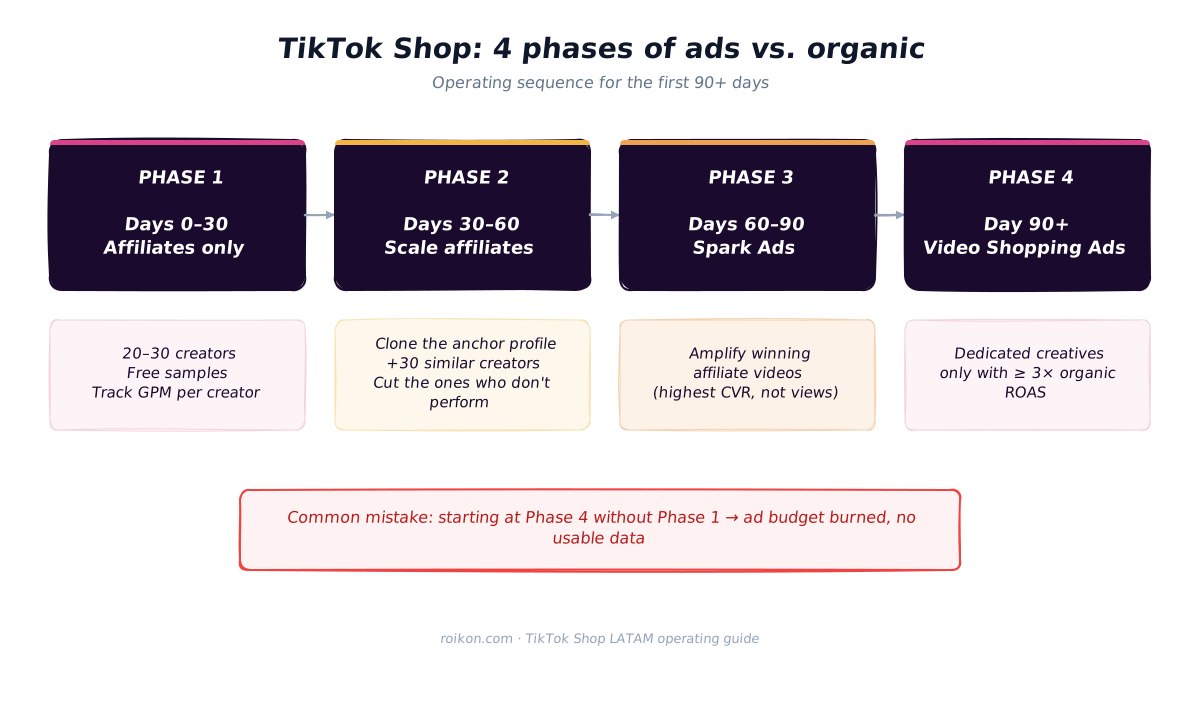
Most brands waste money on TikTok Shop Ads in their first 60 days. The correct order:
Phase 1 (days 0–30): affiliates only. Recruit 20–30 creators. Send free samples. Set affiliate commission in a low-to-mid range that fits your margin. Measure who produces GPM (GMV per 1,000 views) above your category benchmark. Those are your anchor creators.
Phase 2 (days 30–60): scale the affiliate base. Use your anchor creators as the profile reference to recruit 30+ similar creators. Ignore the ones who don't produce GPM, regardless of follower count.
Phase 3 (days 60–90): Spark Ads on winning organic content. Identify affiliate videos with the highest CVR (not the most views). Pay to amplify those specific videos via Spark Ads — it's the format that multiplies the reach of content that already converts. Don't make new ad creatives; amplify organic winners.
Phase 4 (day 90+): Video Shopping Ads with dedicated creatives. Only when you have a creative with 3× ROAS organically is it worth paying for production and scaling with VSA.
The common mistake: starting at Phase 4 without Phase 1. Result: ad budget burned in a month with zero usable data on what works.
The minimum team
You don't need 10 people. You need three functions covered:
- Creator manager. Ongoing recruitment, briefing, per-creator performance tracking. Internal or external. 20–25 hrs/week.
- Ops / logistics / catalog. Catalog loading, pricing, inventory sync, claims handling. 10–15 hrs/week in steady state.
- Analytics + creative direction. Weekly performance review, which content to amplify via Spark Ads, briefs for new creators. 8–10 hrs/week.
Total: ~45 hrs/week steady state. Months 1–2, double the allocation — initial recruitment and catalog load are heavy.
If you hire an agency to run TikTok Shop, demand an hours-per-role breakdown before a flat fee. Serious LATAM agencies bill by hour or by auditable deliverable — avoid the ones charging a retainer with no activity report.
Products that win on TikTok Shop
Patterns repeated across accounts with traction:
Win:
- Demo-able products: visible before/after, transformation, satisfying effect (ASMR, slime, makeup application).
- Beauty, personal care, consumer gadgets, fashion accessories, novelty food.
- AOV in the impulse-purchase zone for your category (low-to-mid).
- Brands with a point-of-view or story a creator can amplify in 30 seconds.
- Focused catalogs (5–30 SKUs) with high rotation.
Lose:
- Complex products that need long explanation (insurance, B2B software).
- High AOV — outside your audience's impulse-purchase zone.
- Seasonal products with a short window (costumes, highly specific gifts) — creator recruitment cycle is longer than the window.
- Regulated categories (alcohol, prescription-free pharma, supplements with health claims).
If your product falls into "lose," it doesn't mean TikTok Shop is dead — it means you'll compete with a worse cost structure. Only worth it if you don't have alternatives.
Rookie mistakes brands make
1. Treating TikTok Shop as an ad network. "Let's run a spend test to validate." That works for Meta. Not for TikTok Shop. The channel validates with organic affiliate creators, not spend.
2. Setting affiliate commission too low. Creators compare your offer against every available brand and pick the best one. Keep it in a low-to-mid range — below that you don't attract decent talent, and above that you erase margin for ads and operations.
3. Sending samples with no filter. Mailing 300 random creators produces zero ROI. Filter on: (a) aligned niche, (b) 10+ videos with >5K views each, (c) engagement rate >3 %. Twenty filtered beats 300 random.
4. Not tracking GPM per creator. If you don't know how much GMV each creator generates per 1,000 views, you don't know who to amplify or who to cut. Seller Center shows it — use it.
5. Optimizing conversion before discovery. "Our cart CVR is low, we need checkout optimization." When your product barely clears 5K daily views, the problem isn't checkout — it's that nobody's discovering you. Organic volume first, funnel optimization second.
Compared to other channels
If you're choosing between TikTok Shop and other marketplaces, see the detailed TikTok Shop vs Mercado Libre. Spoiler: they're not substitutes — they're complementary, and most mid-market brands end up running both.
Quick takes vs. alternatives:
- vs. Meta Ads (Facebook/Instagram): Meta has better attribution modeling and retargeting. TikTok Shop has cheaper organic CPA and better brand lift.
- vs. Amazon: Amazon wins on direct intent and logistics. TikTok Shop wins on discovery and acquisition.
- vs. Shopify direct: Shopify gives you full control over data and margin, but you pay 100 % of the traffic. TikTok Shop "gives" you traffic via creators.
The answer is almost always "both, with different jobs," not "either/or."
Unit economics: the math you owe yourself before launching
Before investing, build this:
| Variable | Your number |
|---|---|
| Retail price | ___ |
| COGS | ___ |
| TikTok Shop platform fee | ___ |
| Affiliate commission (low-to-mid range) | ___ |
| Logistics (shipping + packaging) | ___ |
| VAT on commissions | ___ |
| Pre-ads contribution margin | ___ |
| Projected ads (target ACoS given your margin) | ___ |
| Net contribution margin | ___ |
| Implied CAC (organic replenishment) | ___ |
Rule: if net contribution margin is < 20 % of retail price, TikTok Shop isn't your primary channel. You'll work hard to earn little, and the first scale month will break cash flow.
What to watch weekly
A minimum operating dashboard:
- Organic GMV vs. amplified (Spark Ads). If organic drops and amplified rises, you're buying growth that isn't sustainable.
- Active affiliate creator count. Active = at least one video published in the last 14 days. Target: 20+ in phase 1, 50+ in phase 2.
- Average GPM per creator. Identify the top 20 %, support them; bottom 40 %, replace them.
- Catalog CVR. If it drops month over month, check main images, reviews, price vs. competition.
- Return rate. If it climbs above 10 %, the problem is usually description vs. creator-video representation.
- Inventory per SKU. TikTok Shop punishes stockouts during a viral moment with 2–3 weeks of ranking recovery lag.
For full metric definitions, see e-commerce metrics glossary.
Realistic launch budget
For a DTC brand already operating in another channel, the line items to fund:
- Samples for initial recruitment (~50 creators × your SKU COGS)
- Creator manager (internal time or contractor)
- Ops + analytics (internal time)
- Supporting content (new brand creatives)
- Spark Ads (phase 3, optional until day 60)
- Inventory buffer for viral spikes: 1.5× projected monthly stock
Typically no positive ROI until day 45–60. If you can't carry 60 days without positive net, don't launch.
Launch-readiness checklist
- Gross margin ≥ 40 % (≥ 50 % ideal).
- Catalog with 5+ demo-able SKUs prioritized.
- Inventory to support 4× your current monthly sales projection.
- Launch budget separate from current P&L (60 days).
- Person or agency identified to manage creators.
- Logistics process that can handle 3× spikes without breaking.
- Customer service rules defined for returns and claims in ≤ 24 hrs.
Less than 5 boxes? You're not ready. Fix what's pending before opening the account.
Next step
If you want your case mapped specifically — real margin, product type, logistics capacity — against TikTok Shop viability, book a working session with Roikon. First deliverable is your unit economics calc applied to your numbers, not a generic deck.
If you prefer DIY, browse the other guides in resources or the specific TikTok Shop vs Mercado Libre comparison.