Guide
UGC and Creator Commerce in LATAM: an operating framework for DTC brands (2026)
What UGC really is, how Creator Commerce works in LATAM, what each model costs, and when it's worth it. No agency hype — real numbers.
TL;DR — UGC, influencer marketing, Creator Commerce, and Affiliate Marketing are four distinct models with different economics, rights, and metrics. Most DTC brands confuse them and end up paying the worst trade-off of each. This guide takes them apart: what they are, what they cost in LATAM in 2026, when to use each one, and how to operate a creator engine that doesn't collapse on day 45.
The four models people blur together
Operator glossary first — if your team uses these terms as synonyms, you're paying wrong:
1. UGC (User-Generated Content). Content made by real "users" (or paid creators acting as users). The brand licenses the asset and uses it in ads / PDPs / email. The creator doesn't need to distribute it on their own channel. You pay for the asset, not the reach.
2. Influencer Marketing. You hire a creator with an audience to post on their own channel. You pay for the channel's reach and authority. You own the message, not the asset.
3. Creator Commerce (TikTok Shop affiliates / Amazon Influencer / Shopify Collabs). Creators post content on their channels with an affiliate link/commission. The sale is traceable to the creator and paid on sale. Variable pay, not fixed.
4. Traditional Affiliate Marketing. Publishers, blogs, niche sites, or creators distributing your link under a CPA scheme. Typically via networks (Awin, CJ, Impact) or proprietary programs. Last-click attribution, commission per sale.
Quick table:
| Model | Payment | Asset | Distribution | Tracking |
|---|---|---|---|---|
| UGC | Fixed per piece | Yours | You distribute | Ad metrics |
| Influencer | Fixed per post | Creator's | Creator's channel | Promo code / UTM |
| Creator Commerce | Variable (commission) | Creator's | Creator's channel | Platform-native |
| Traditional affiliate | Variable (commission) | Publisher's | Publisher's channel | Affiliate network / cookie |
The most expensive mix-up: paying a fixed influencer fee and treating the content as UGC without buying usage rights. Result: a lot of money burned with no assets to amplify.
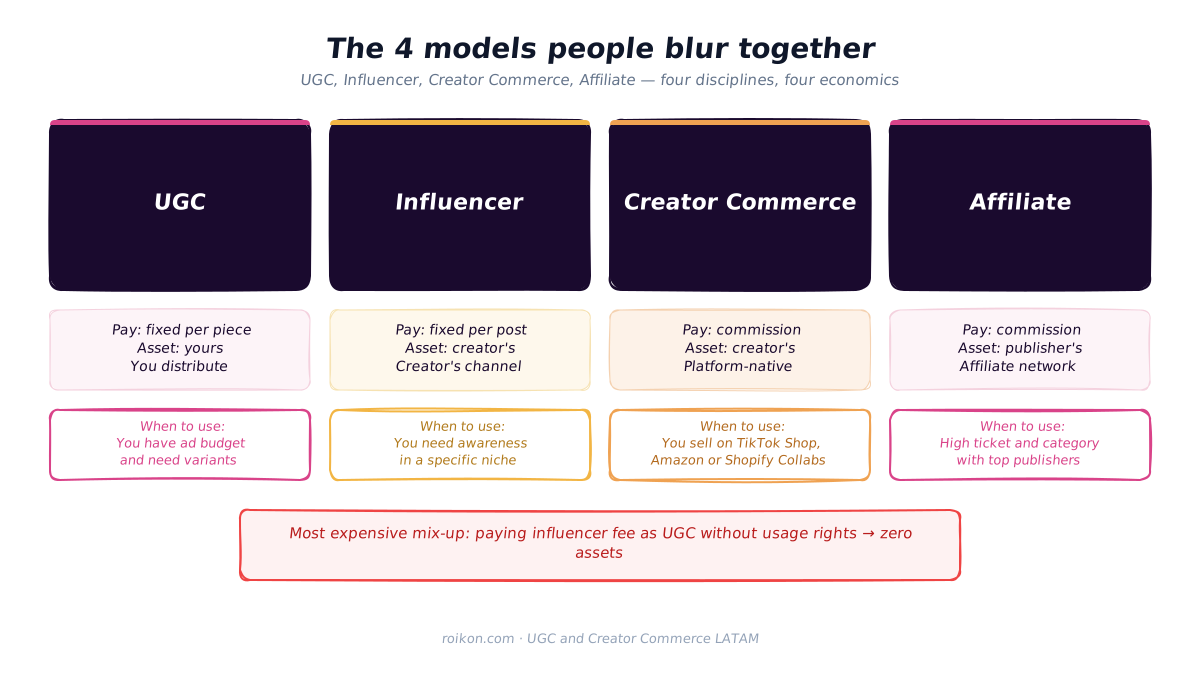
The economic structure of each model
Specific numbers shift by category, platform, and moment — the payment structure doesn't. Understanding the structure prevents the most expensive mistake: applying one model's logic to another.
UGC
Fixed fee per piece, with rights negotiated separately. Whitelisting (running ads from the creator's account) is an extra on top of the base fee. "Iceberg" batches (multiple variants off one brief) lower the cost per asset versus briefing each video individually. Mid-sized creators acting as UGC charge more than pure creators without followers — you're implicitly paying for their profile as a quality signal.
Influencer marketing
Fixed fee per post, scaling with audience size and real engagement rate. The gap between nano, micro, mid and large isn't linear: the micro-to-mid transition typically multiplies the fee 3–5×, not 2×. Real engagement matters more than follower count: a nano at 8 % engagement outperforms a mid at 1 %.
Creator Commerce (TikTok Shop / Amazon Influencer)
Variable commission per sale, set by the brand. Keep it in a low-to-mid range to protect margin while staying attractive to creators — too low pushes talent away, too high erases your contribution margin. Free sample to the creator — you absorb the COGS, no fixed fee. For top creators you can offer GCPA (Guaranteed Commission Per Action) as an added incentive on the first video that hits a baseline view count.
Traditional affiliate
Variable commission per sale, also in a low-to-mid range depending on margin and category. The affiliate network charges a fixed monthly platform fee plus % on commissions paid. Proactive activation (pitching top publishers) eats internal team or agency hours — not "set and forget".
Common mistake: assuming Creator Commerce "is free because it's paid on sale". It isn't — samples, creator management time, and initial setup cost money before the first peso of revenue.
When to use each model
UGC
Use it when:
- You have ad budget (Meta / TikTok Ads / Google) and need fresh creative variants every 14–30 days.
- Your PDP benefits from authentic testimonial video (beauty, wellness, fitness, food).
- You want assets for email, landing pages, Amazon A+ (with Amazon's policy check).
Avoid it when:
- You're not running ads. UGC without paid distribution is waste.
- Your product is B2B or highly technical.
- You want organic reach — UGC doesn't deliver that.
Influencer Marketing
Use it when:
- You need brand awareness in a specific niche (fitness, gaming, parenting).
- Your paid-ad CAC is climbing and you need a different channel.
- Your product requires authority or endorsement (supplements, tools, finance).
Avoid it when:
- You can't measure lift beyond a promo code (real impact is hard to attribute).
- Your margin is < 25 % — the ROI rarely covers the fixed fee.
- You want short-term direct sales — influencer pays more in brand than in conversion.
Creator Commerce
Use it when:
- You sell on TikTok Shop, Amazon, Shopify Collabs, or Mercado Libre (with affiliate program).
- Your margin absorbs an extra 15–25 % for creators.
- You can operate the recruiting of 20–50 active creators (time + team).
Avoid it when:
- You have no presence on a platform with native payout — running a self-built affiliate program is complex.
- Your product doesn't demo well on video.
For operating detail specific to TikTok Shop, see the TikTok Shop LATAM guide.
Traditional affiliate
Use it when:
- Your product has a high AOV that justifies a top publisher pitching you.
- You're in a category with established publishers (tech, finance, travel).
- You have the margin to pay 10–15 % without flinching.
Avoid it when:
- Your ticket is low — affiliate networks have payout minimums that kill the economics on low-ticket products.
- You're a young brand without recognition — serious publishers don't pitch brands without a track record.
How to operate UGC well
Most brands fail at the same three points: sourcing, briefing, and rights. The operating layer:
Sourcing
Sources that work in LATAM (2026):
- UGC marketplace platforms: Insense, Billo, JoinBrands (Billo has MX coverage). Mid quality, high volume, standardized fees set by the platform.
- Direct recruiting on TikTok / Instagram: search #UGCMéxico or #UGCCreator, filter by "services list" in bio. Fees more negotiable than on marketplaces.
- Your own audience: customers who already left reviews can become creators. Good pay, authentic — the best ROI.
Non-negotiable filters when hiring:
- 5+ prior pieces on their profile in a style close to yours.
- They know how to light a shot (front camera, minimum natural light).
- Clear audio (not just music on top).
- Reply in < 24 hrs during the brief conversation.
Briefing
Classic mistake: an 8-page brief no one reads. What works on a single page:
- The product in 3 lines. What it is, who it's for, the problem it solves.
- The required hook (first 3 seconds). Example: "I tried 8 moisturizers and this was the only one that worked for my dry skin."
- The 3 core benefits to mention (not 15).
- The CTA. "Link in bio," "Code ROIKON20 at checkout," etc.
- What NOT to do. Medical claims, competitor comparisons by name, ALL CAPS voiceover, copyrighted music.
- Usage rights. What you can do with the asset, for how long, on which channels.
- Deadline + deliverables. Date, format (vertical 9:16, duration, captions or not).
Rights
The point almost no one negotiates well. Standard terms:
- Organic use on the creator's channel: always included.
- Use on brand-owned channels: explicitly include for 12 months minimum.
- Use in paid ads (whitelisting / dark posts): explicitly include. This is the line item with real cost.
- Use of likeness on website, email, A+ Content: specify.
- Post-12-month renewal: specify (or assume 50 % of the original fee).
A 1-page contract with those seven points signed before payment. No contract = chaos six months later.
Metrics that tell you it's working
UGC in ads
- Hook rate (3s view rate): % of impressions that watch the first 3 seconds. Benchmark: 40 %+ on TikTok, 25 %+ on Meta.
- Hold rate (15s view rate): % reaching the 15-second mark. Benchmark: 15 %+ TikTok, 10 %+ Meta.
- Thumb-stop ratio: hook rate / impressions.
- CPM: cost per thousand impressions.
- CPA: cost per acquisition attributed to the ad.
- Creative CVR: sales generated ÷ clicks on the creative.
If a UGC creative drops below hook/hold benchmarks in 72 hours of running, cut it. Don't "let it run to see if it picks up".
Influencer
- Organic CPM: campaign cost ÷ organic impressions ÷ 1,000.
- Real engagement rate: (likes + comments + saves + shares) ÷ followers. Benchmark: 3 %+ is healthy, under 1 % is a dead channel.
- Promo code usage: sales tied to the code.
- Brand search lift: brand searches in the 7 days post-post vs. baseline.
Creator Commerce
- GPM (GMV per Mille): GMV ÷ 1,000 views. Measures how efficiently creator content converts views into GMV — reference in metrics glossary.
- Active creator count: creators with at least one video posted in the last 14 days.
- Creator retention: % of creators posting at least one video in month-2 after the first.
- Top 10 % GMV concentration: in a mature program, the top 10 % of creators delivers ~70 % of GMV. Normal.
Traditional affiliate
- Publisher-level ROAS: per individual publisher.
- EPC (Earnings Per Click): commission ÷ clicks sent.
- Reversal rate: % of conversions reversed (returns, fraud).
Full definitions in the ecommerce metrics glossary.
Typical mistakes in creator programs
1. Mixing UGC and influencer under the same contract. Fees and rights are incompatible. Separate the programs with their own budgets and teams.
2. Not running rotation. The same creative loses 40 % of hook rate after 14 days in ads. You need a pipeline of 8–15 new UGCs per month if you run ads seriously.
3. Centralizing everything in an agency without internal management. Outsourcing recruiting to an agency without measuring per-creator performance is giving away margin. What works: agency handles sourcing + briefing, you measure and decide who to scale.
4. Paying late. Creators with a bad payment experience don't come back. Pay within 7 days of delivery. It's the #1 differentiator for keeping good creators in LATAM.
5. Ignoring rights until you need them. Six months later you want to run the winning creative in ads. The creator doesn't reply. Or asks for 3× the original fee. Negotiate rights in the first contract.
6. Underestimating creator-management time. A 20-active-creator program eats 15–25 hrs/week in sourcing + briefing + review + payment. It's not "the marketing manager in their spare time".
Roikon POV: what changed in 2025–2026
Three patterns we've seen since January 2025 that weren't showing up before:
1. UGC pricing dropped 30 % in saturated categories, rose 40 % in niches. Beauty, fashion, fitness — 10× more creators than two years ago. Competition dropped prices. But technical categories (health, pet, tools, finance) have thin supply and good creators charge more.
2. TikTok Shop spawned a new category: "creator operator". 20K–100K creators specializing in selling DTC products on TikTok Shop. They're not traditional influencers — they're in-feed store operators. Their minimum fee is lower than a comparable influencer but they demand a higher affiliate commission (20–30 %).
3. AI-generated creator content is appearing. Synthetic avatars "acting" as UGC. Lower price, lower quality. In 18–25 audiences, rejection is high — they spot it. For very specific niches (tech, B2B) it can make sense on cost. For mass DTC, not yet.
Next step
If you want to map which model fits your brand given your specific margin, book a session with Roikon. We work with DTC brands operating a UGC + influencer + Creator Commerce mix, and the first deliverable is unit economics by model.
Specific channels: TikTok Shop LATAM · Amazon optimization · TikTok Shop vs Mercado Libre · Ecommerce metrics glossary.