Guide
Selling on Mercado Libre Mexico: an operator's guide for DTC brands (2026)
How to operate Mercado Libre MX as a real DTC channel: reputation, Full, Product Ads, catalog, Premium listings. No theory — levers that move the needle.
TL;DR — Mercado Libre in Mexico isn't "the old cousin" of LATAM ecommerce — it's the biggest channel in the country, with its own operating rules and levers that don't exist on Shopify or Amazon. This is the operating framework: which levers move reputation, how to decide between Full and seller-fulfilled, when to activate Product Ads, which listing type to pick, and the mistakes that quietly destroy margin.
Why Mercado Libre is still the #1 channel in Mexico
Three reasons that won't shift soon:
- Consumer penetration. Roughly 60 % of Mexico's total ecommerce flows through Mercado Libre per AMVO's 2024 Online Retail Study. It isn't "another platform" — it's the default.
- Pre-paid consumer trust. The Mexican consumer has 25+ years of relationship with ML. They know how to complain, rate, and compare. Your education cost is zero.
- National logistics solved. Mercado Envíos Full covers the country with professional SLAs a DTC brand can't replicate with its own 3PL at similar scale.
Ignoring Mercado Libre because "we want control" is giving competitors free volume. The right question isn't whether to be there — it's how to operate without getting margin eaten.
Anatomy of a listing that converts
Nine visible elements plus the "invisible engine" of reputation and algorithm rules:
- Title. Primary keyword + brand + critical attributes. ML rewards long, attribute-rich titles (not short "brand only" ones).
- Photos. Minimum 4, ideal 6–8. The first photo drives click-through in search.
- Price + interest-free installments. Premium listings surface MSI (meses sin intereses) automatically and convert significantly better in mid/high-ticket categories.
- Seller reputation. Green / yellow / red. The gap between green and yellow can cut the same listing's conversion by up to 30 %.
- Product reviews. Stars + count. Below 4.5 stars with few reviews, conversion drops sharply.
- Technical attributes. ML uses them for internal filters and search. Empty fields = you don't appear when users filter.
- Description. Long, structured with bullets and sections. ML indexes body text for internal SEO.
- Stock. Out-of-stock listings drop fast in ranking and it costs 2–3 weeks to recover once you restock.
- Public Q&A. Every question is a ranking + conversion opportunity. Fast answers are a positive signal to the algorithm.
Invisible engine: response speed, cancellation rate, handling time, ratings. All feed the algorithm deciding how much free organic traffic you get.
Reputation: the lever most brands underestimate
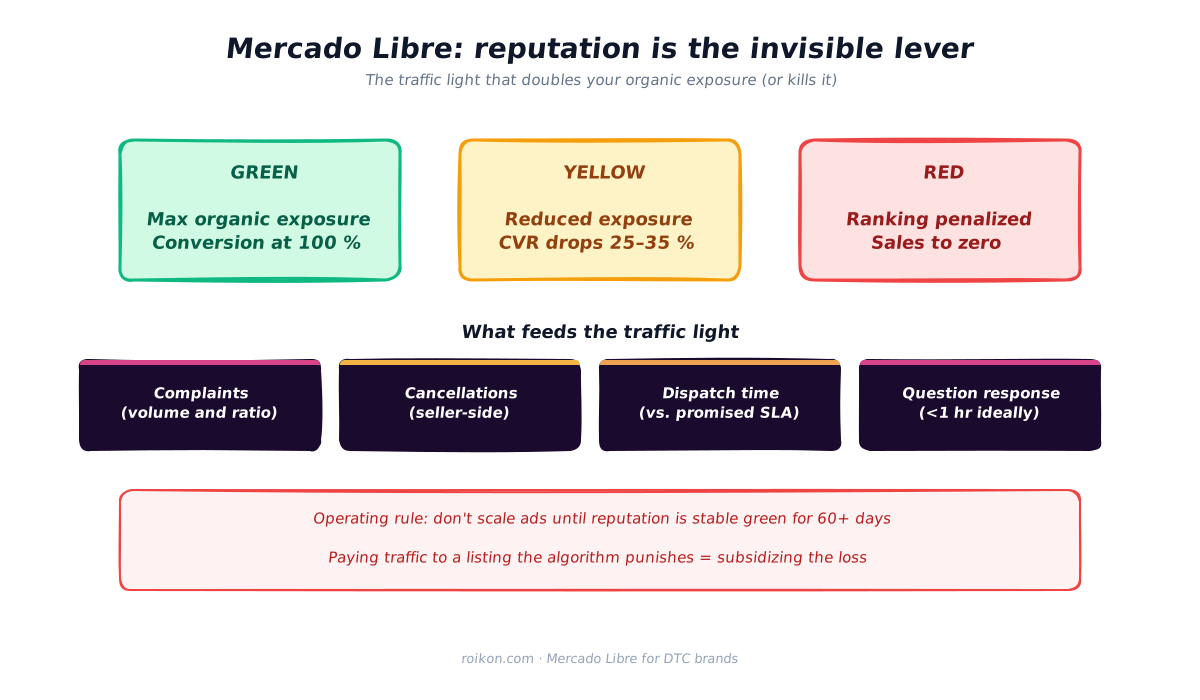
Mercado Libre's reputation is a traffic-light system (green / yellow / red) calculated on your recent orders. Inputs:
- Complaints. Open complaints volume, proportion vs. total orders.
- Cancellations. Seller-side cancellations (not buyer-side).
- Dispatch time. Meeting your promised SLA (48 hrs, 72 hrs, etc.).
- Question response time. Ideally under 1 hour in business hours.
Holding green reputation doubles your organic exposure in internal search. Dropping from green to yellow can cut the same listing's conversion 25–35 %. Reputation isn't cosmetic — it's profitable.
Operating rule: don't scale ads until your reputation is stable green for 60+ days. You're paying to send traffic to a listing the algorithm is simultaneously punishing.
Listing types: Clásica vs. Premium
Mercado Libre offers two main modes for brand sellers:
Clásica: lower commission, no interest-free installments. Useful for low tickets or to test a product before committing to Premium.
Premium: higher commission but with automatic MSI (3, 6, 12-month interest-free) + better internal placement + higher conversion on mid/high tickets.
Decision rule: if your AOV sits above your category's impulse-purchase zone, Premium almost always earns back its higher commission through conversion lift. For low tickets (high repeat, consumable), Clásica is usually more profitable.
No universal answer — it's a per-SKU contribution-margin exercise. Run a 14-day window, compare net conversion.
Full vs. seller-fulfilled: the operational decision
Mercado Envíos Full is ML's FBA equivalent: you send inventory to ML's distribution center; they handle pick-pack-ship, returns, and logistics-side customer care.
Full wins when:
- Mid-to-high ticket (Full's per-unit cost dilutes into the commission).
- Predictable volume (consolidating at their DCs is cheaper).
- Categories where delivery speed drives reputation (fashion, beauty, tech).
- You can't run 7×24 fulfillment with consistent SLAs in-house.
Seller-fulfilled wins when:
- Low ticket, tight margin (Full can eat contribution).
- Fragile, bulky, or special-handling products.
- You already have a 3PL with competitive SLAs.
- Your SKU has strong seasonality (you don't want it parked in Full DCs).
Hybrid is valid and common: hero SKUs on Full, long-tail SKUs on seller-fulfilled.
Product Ads: the loop with organic
Mercado Ads (Product Ads) is ML's internal advertising system, comparable to Amazon Sponsored Products. It runs on the same search engine, in the same feed, under the same ranking engine.
Minimum structure:
- Automatic campaigns for discovery — ML picks relevant keywords from your listing. 30–60 days to find what converts.
- Manual (exact keyword) campaigns with validated terms from Auto. Scale what works.
- Defensive campaigns on your own brand + common misspellings. Blocks competitors from bidding on your name.
- Aggressive campaigns on direct competitors (optional). High ACoS but steals market share.
Target ACoS: ≤ 50 % of gross margin. If margin is 35 %, aim for ACoS ≤ 17–18 %. Above that, you're subsidizing sales.
Virtuous loop: every paid sale feeds organic ranking. Don't treat Product Ads as a "parallel channel" — it's an algorithm accelerator. But if reputation is yellow, Product Ads just accelerates the loss.
Mercado Líder: the badge that multiplies
Mercado Líder is the badge ML awards to sellers with high volume, sustained green reputation, and low complaint rate. Three tiers: Mercado Líder, Mercado Líder Gold, Mercado Líder Platinum.
Real benefits:
- Higher organic exposure on the same listings.
- Priority in dispute resolution.
- Access to tools and beta programs.
- Visible badge on listings that lifts conversion (trust effect).
It isn't quick to earn: 3–6 months of consistent volume with stable reputation. But once achieved, per-listing ROI rises without changing product or price.
Mistakes that quietly destroy margin
1. Uploading the full catalog uncurated. "We upload 200 SKUs and see what sells." Result: internal ranking diffused across weak SKUs, your hero SKU sinks. Upload the top 10–20 first, earn ranking, then expand.
2. Competing only on price. Dropping 10 % to win the comparison seems logical. But if your reputation is yellow and the competitor's is green, you'll lose the sale even priced 15 % lower. Reputation > price in ties.
3. Leaving questions unanswered. Slow or generic answers cut conversion and damage reputation. Template frequent answers, hand-write specifics.
4. Skipping structured attributes. Empty technical fields drop you from filters when a user filters by size, color, or material. Filling attributes is free and moves ranking.
5. Splitting variants across separate listings. ML rewards grouped variants (one listing, multiple sizes/colors). Splitting fragments reviews, ranking, and sales.
6. Scaling ads before reputation. New product + no reputation history + aggressive Product Ads = paying for traffic that won't convert. Wait to stabilize reputation.
Weekly metrics
Minimum operating dashboard for serious MLM:
- Reputation (color + trend). Stable green is the floor.
- Conversion per listing. Compared against category benchmark (shown in your ML Seller Central).
- Question response rate. Target: <1 hr during business hours.
- Cancellation rate. Target: <2 %.
- Average dispatch time. Within promised SLA 95 %+ of the time.
- ACoS per campaign. Not the aggregate — per campaign, at the diff level.
- Full inventory sell-through. If it drops, reduce the next shipment.
- Repeat purchase rate. Hidden but key — see metrics glossary.
Roikon POV: what no one tells you
Three patterns we see on accounts with real traction:
1. Brands that "abandon" Mercado Libre usually regret it in 60 days. When TikTok Shop takes off, some brands redirect the entire team there. ML drops from lack of maintenance (not the algorithm) and they lose their revenue floor. Keep a minimum ML operation running wherever you already have traction.
2. First green reputation takes 45–60 days and is worth more than any ad. There's no shortcut. Don't buy "quick volume" to push reputation — ML detects artificial patterns. Operational patience during ramp-up pays more than ad spend.
3. Winning listings are built through iterative friction, not "perfect launch." Publish imperfect and iterate in 14 days beats waiting 60 days for a perfect listing. The algorithm needs real performance data to start promoting you.
How it fits with other channels
Detailed comparison in TikTok Shop vs Mercado Libre. Summary:
- ML + Shopify: ML for volume and broad acquisition; Shopify for margin, first-party data, and premium customers. Unified inventory is key.
- ML + Amazon MX: you can run both but it requires dedicated teams — algorithm rules differ, and so does customer care.
- ML + TikTok Shop: complementary, not substitutes. ML captures search intent; TikTok Shop creates intent through discovery.
Readiness checklist
- Prioritized catalog of 10–20 top SKUs.
- Inventory to absorb a 3× organic spike.
- High-quality photos (minimum 6 per SKU) ready.
- Full structured attributes for every SKU.
- Question-response process with <1 hr SLA.
- Clásica/Premium decision made per SKU.
- Full/seller-fulfilled decision made per SKU.
- Reputation plan: 45–60 days of clean operation before scaling ads.
- Per-SKU CAC / conversion tracking configured.
Next step
If you're building your Mercado Libre operation or want to audit an existing one, book a session with Roikon. The deliverable is a prioritized per-SKU plan with expected impact, not a generic diagnostic.
Complementary guides: TikTok Shop LATAM · Amazon optimization · UGC and Creator Commerce · TikTok Shop vs Mercado Libre · Ecommerce metrics glossary.