Guide
Performance creative for DTC: producing creative that actually sells (2026)
Operating framework for performance creative that moves CVR and ROAS: hook rate, variants, iteration, testing, and the signals that predict winners.
TL;DR — Performance creative isn't "making pretty videos for ads." It's a system of production + testing + signal reading that decides, in hours, which variant to scale and which to kill. Most DTC brands that "fail at ads" actually fail at creative ops: too few variants, poor reading of early metrics, slow iteration loop. This is the operating framework — what to produce, how to test, which metric to read first, and the mistake that drains budget the hardest.
What separates "creative" from "performance creative"
Two distinct disciplines sharing a name:
Brand creative. Well-produced asset, storytelling, positioning. Measured by brand lift, awareness, memorability. Long cycle: produced per quarter, lives for months.
Performance creative. Asset designed to convert in a specific channel (Meta, TikTok Ads, Amazon Ads, TikTok Shop). Measured by hook rate, CVR, CPA. Short cycle: produced in days, tested in hours, replaced in weeks.
Confusing the two is the #1 reason brands "have great creative that doesn't sell." What matters in performance is different: fast open, clear demo, preempted objection, unambiguous CTA.
Anatomy of a winning performance creative
Four components, in impact order:
1. Hook (first 3 seconds). The only reliable predictor that anything else gets watched. Hook rate benchmarks (3s view rate):
- TikTok / TikTok Shop: 40 %+ is healthy, <25 % is broken.
- Meta (Feed + Reels): 25 %+ healthy, <15 % broken.
- YouTube Shorts: 30 %+ healthy.
Hook types that work:
- Direct question: "Why did no moisturizer work for me?"
- Counter-claim: "I stopped using vitamin C. Here's what changed."
- Visual problem: before/after immediately, no context.
- Pattern interrupt: something unexpected that stops the scroll.
2. Demo / proof (seconds 3–20). Product solving the problem on-screen. Rule: one idea per creative. Mixing "hydrates + anti-age + paraben-free" dilutes. Pick one benefit, amplify it.
3. Preempted objection (seconds 20–40). The most common objection in your category, answered before it shows up: "Does it work on sensitive skin?", "How fast is it visible?", "Is it safe during pregnancy?". Answering it in-video lifts CVR more than adding reviews to the PDP.
4. Unambiguous CTA (last 5 seconds). "Link in bio," "Code ROIKON20 at checkout," "Tap the icon to buy." No CTA or a generic one drops CVR by 30–50 %.
How many variants to produce
The operating decision with the biggest impact — and where most brands fail.
Base rule: produce 8–15 variants of each winning angle every 14 days. Not 2, not 3. Eight minimum.
Why so many? Meta and TikTok's algorithms need volume to identify the winner. Running 3 variants and "letting the algorithm decide" among 3 isn't data — it's anecdote. Running 15 and cutting the worst 10 with statistical data is performance creative.
What varies between variants?
- Hook: 3–5 different hooks on the same benefit.
- Format: talking head, voiceover + broll, split screen, text overlay.
- Creator: nano vs. micro, female vs. male, presenter age.
- Duration: 15s, 30s, 45s.
- Background / setting: home, outdoor, studio, office.
Do NOT vary product or CTA simultaneously. Isolate one variable to read the signal.
The iteration cycle that works
14-day sprint:
Days 1–3: production. 8–15 fresh variants based on validated angles + 2–3 exploratory.
Day 4: upload + launch. Audience and budget equal across variants (same campaign, same ad set, variants as distinct ads). Minimum statistical budget: enough for 1,000–2,000 impressions per variant per day.
Days 5–7: early signal reading. Hook rate after 10,000 impressions. If below the category benchmark, kill. Don't "wait and see" — it doesn't improve.
Days 8–10: CVR reading. From variants with healthy hook rate, measure CVR after 3,000+ clicks. Those converting 1.5× the average are scale candidates.
Days 11–14: scale + new brief. Scale budget on winners. Brief next 8–15 variants: what to replicate from the winner, what to vary.
Fatal mistake: waiting 30 days to decide. Every day a non-working creative runs is burned budget.
The metrics to read (and in what order)
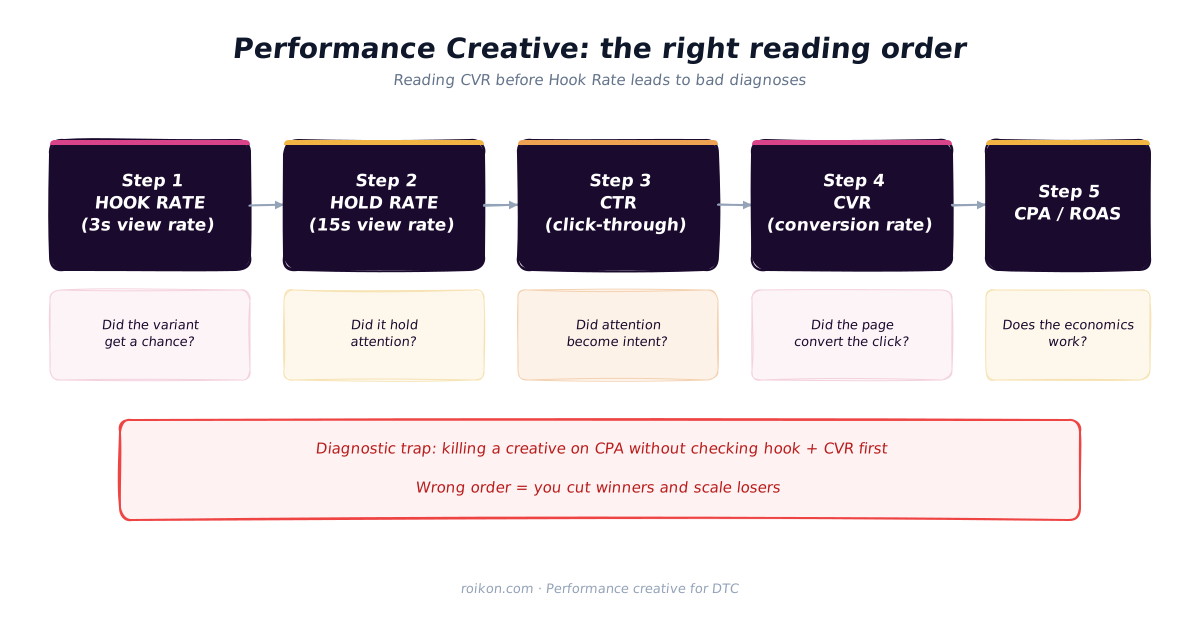
Order matters. Reading CVR before hook rate leads to bad diagnoses.
Step 1 — Hook rate (3s view rate): did the variant get a chance? If it doesn't clear 25 % on Meta / 40 % on TikTok, kill. The rest doesn't matter.
Step 2 — Hold rate (15s view rate): did it hold attention? Benchmark: 15 %+ on TikTok, 10 %+ on Meta. Low hold with high hook = demo is failing.
Step 3 — CTR (click-through rate): did attention become intent? DTC ads: 2–5 % is healthy. <1 % indicates weak CTA or misalignment.
Step 4 — CVR (conversion rate): did the page convert the click? If PDP CVR drops across all ads, the problem is the PDP, not the creative.
Step 5 — CPA / ROAS: does the creative's economics work? Only look here once the first four are healthy. Killing on CPA alone is a diagnosis error.
Full definitions in the ecommerce metrics glossary.
Production: in-house, external, or hybrid
Three valid models:
Fully in-house. Own team with creator + editor + performance director. Pros: speed, short data loop, product knowledge. Cons: capex in team, limited to your team's style. Works when you operate 50K+ in ad spend/month sustainably.
Agency / external production. Pros: specialized talent, format variety. Cons: slower cycle, less data ownership, hard to iterate fast. Works for specific campaigns or launches, not continuous ops.
Per-piece UGC creators + internal editor. Most common model in mid-market DTC. Recruit creators by piece (see UGC and Creator Commerce), edit internally or with a freelance editor, scale variants from the same raw material. Combines speed + diversity + controlled cost.
Pick by ad volume and needed iteration speed. No universal answer.
Mistakes that drain budget
1. Too few variants, "let the algorithm decide." Shipping 3 variants into a large audience hoping Meta or TikTok "finds the winner" isn't performance creative. It's luck. Minimum 8 variants per sprint.
2. Reading CPA as the first signal. High CPA on day 2 could be noise or signal. Without reading hook rate and CVR first, you don't know which. Order the diagnosis.
3. Reusing the same creative 60+ days. The same creative loses 40 % of its hook rate after 14 days in ads (creative fatigue). Even the winner needs replacement or refresh.
4. Not varying the hook. Teams change the product, CTA, and music — but keep the same hook. The hook matters most. Vary 3–5 hooks per sprint on the same benefit.
5. Confusing viral with performance. A video with 2M views and 0 sales is content, not performance creative. Don't chase views; chase CVR on top of hook rate.
6. Producing high-fidelity when the channel wants the opposite. Ads that "look like ads" lose on TikTok. TikTok performance demands UGC aesthetic even if you produce it with a pro team.
Predictive signals (without waiting for ROAS)
Indicators that, within 24–72 hours, predict whether a creative will work:
- Hook rate above benchmark in the first 5,000 impressions.
- Sustained 15s hold rate without a sharp drop.
- Comments asking purchase questions ("where do I get it?", "do you ship to…?").
- Save rate or share rate above 1 %.
- Profile visits above baseline — signals genuine interest beyond the scroll.
Signals that predict failure:
- Hook rate well below benchmark. Cut before spending more.
- Negative comments or "not relevant" flags.
- Audience skipping at 0:05 with a sharp retention valley.
Roikon POV: what changed in 2025–2026
Three patterns shaping today's performance creative:
1. AI-assisted creative cuts variant cost but not the value of a hook. Generating 30 variants with AI (swapping backgrounds, translating, trimming) is trivial now. The hook remains manual, human, and the difference between winning and losing. AI accelerates production; it doesn't replace creative judgment.
2. TikTok Spark Ads democratized amplification. You don't need to produce a "perfect ad" — you can amplify a creator's organic video that already hit. The shift: performance creative now includes "discover what's working organically and amplify it," not only "produce new."
3. Creative lifecycle shrank from 30 to 14 days. Creative fatigue hits faster. Brands not producing every 14 days lose competitiveness. It isn't optional — it's operations.
How it fits with other channels
Performance creative is the lever that connects every acquisition channel:
- Meta Ads / TikTok Ads: constantly consume variants. This is your most demanding customer.
- TikTok Shop / Amazon Ads: reuse winning creatives with minimal adaptations. Amplify with Spark Ads on TikTok Shop.
- Email / CRM: winning videos get a second life in email flows.
- PDP / site: the best performance creatives become product videos.
A winning creative doesn't die after the ad — it rotates across your whole stack.
Readiness checklist
- Validated angles (at least 2) on your value prop.
- Process to produce 8–15 variants every 14 days.
- Naming convention to track variants.
- Dashboards with hook rate, hold rate, CTR, CVR per creative.
- Decision SLA: kill / scale in under 72 hrs.
- Test budget separated from scale budget.
- UGC creator pipeline or production partner ready for fast briefs.
Next step
If your ads are running but you struggle to understand why some creatives win and others don't, book a session with Roikon. We work performance creative as an operating system, not as one-off production.
Complementary guides: UGC and Creator Commerce · TikTok Shop LATAM · Amazon optimization · Ecommerce metrics glossary.