Guide
Social commerce in LATAM: how it works, who's winning, what changed in 2026
Social commerce explained for DTC operators in LATAM: what it really is, how it differs from traditional ecommerce, which platforms matter, and how to shape your strategy.
TL;DR — Social commerce in LATAM stopped being "selling via DM" a long time ago. Today it's a stack of platforms (TikTok Shop, Instagram Shop, WhatsApp Business, Mercado Libre with live streaming) that coexists with traditional ecommerce inside the same brand. DTC brands treating it as a parallel channel — alongside D2C and marketplaces — grow 2–3× faster than the ones using it as a "bonus." This is the operating framework: which platforms matter, which don't, how to decide where to enter first, and what team you need.
What social commerce is (and isn't)
Social commerce is any commercial transaction that happens inside a social platform — without leaving for an external site. Purchase, checkout, and post-purchase all live inside the feed, the live stream, the DM, or the Shop tab.
What counts as social commerce:
- TikTok Shop: in-app purchase, with or without an affiliate creator.
- Instagram Shop + native checkout (in enabled markets).
- WhatsApp Business Catalog + Payments (Mexico, Brazil, Colombia).
- Facebook Marketplace with integrated checkout.
- Live streaming commerce (TikTok Live, Instagram Live, Mercado Live).
What doesn't count:
- Meta ads that send to Shopify — that's paid social + ecommerce, not social commerce.
- A link in bio pointing to your external store.
- Stray DMs without native checkout — that's informal sales, not commerce.
The difference matters for two reasons: (1) tracking changes completely — the pixel lives inside the platform, not on your site; (2) the operator needs a different muscle — content + creator management + real-time customer care, not just ad creatives.
Why LATAM is the most interesting social commerce market in the world
Three facts that explain the moment:
- LATAM has the world's highest share of daily time spent on social media per user (3.5+ hours/day average across Mexico, Brazil, Colombia, per DataReportal 2024–2025 public data).
- Smartphone penetration is high but credit card penetration is low — between 30 % and 50 % depending on the country. This pushes alternative payment methods integrated into social apps (Pix in Brazil, CoDi in Mexico, PSE in Colombia) and favors native checkout over checkout on an unfamiliar site.
- The dominant marketplaces (Mercado Libre, Shopee Brazil) already integrated social formats (Mercado Live, Shopee Live). The line between "marketplace" and "social network with checkout" is blurring fast.
This means lessons from the US or China don't translate 1:1. In LATAM, pure D2C scales slower, pure marketplaces leave less margin, and well-operated social commerce captures a rare in-between zone — cheap acquisition + reasonable margin + first-party data.
Platforms that move the needle in 2026
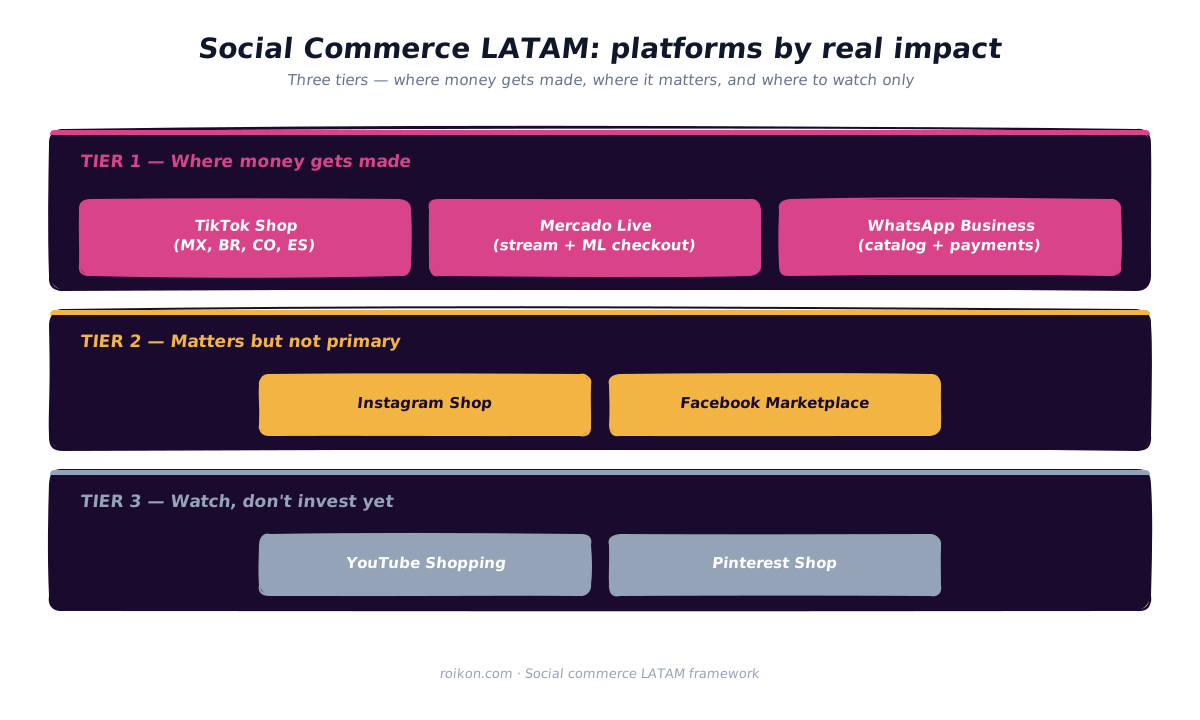
Ranked by real impact, not hype:
Tier 1 — where the money is:
- TikTok Shop in enabled markets (Mexico, Brazil, Colombia, Spain). The cheapest acquisition channel left for DTC in 2026. Detail in TikTok Shop LATAM.
- Mercado Libre with live streaming (Mercado Live). Not "pure social" yet, but it captures price-comparing audiences and converts them inside the stream.
- WhatsApp Business Catalog + Payments. Especially strong in Brazil and growing in Mexico/Colombia. High-ticket in mid-consideration categories (professional beauty, mid-range electronics, premium fashion).
Tier 2 — matters but not primary:
- Instagram Shop. Native checkout coverage is limited in LATAM; in most markets it works as storefront + DM funnel. Useful, not transformative.
- Facebook Marketplace with integrated checkout. High volume in secondhand and low-ticket categories; less relevant for premium DTC.
Tier 3 — watch, don't invest yet:
- YouTube Shopping. Announced LATAM expansion but slow execution. Worth monitoring, not staffing.
- Pinterest Shop. Nearly irrelevant in LATAM for DTC.
How to decide where to enter
Not every brand should start with TikTok Shop. The right order depends on three variables:
1. Your product's average ticket.
- Low ticket + impulse buy: TikTok Shop or Instagram Shop.
- Mid ticket + consideration: WhatsApp Business + catalog, with DM nurture.
- High ticket + consultative sale: WhatsApp Business as primary channel, social as storefront.
2. Your native content format.
- You produce fast vertical video: TikTok Shop.
- You produce photo + stories + carousels: Instagram Shop.
- You produce conversation + testimonials + fast replies: WhatsApp.
3. Where your current customer-creators already are. If customers already tag you on Instagram, start there. If your organic audience is on TikTok, go there. Forget "the trending platform" — what matters is where you already get mentioned without paying.
The minimum team
Social commerce isn't "the marketing lead in their spare time." You need three roles covered with clear ownership:
Creator manager. Recruits, filters, briefs, and tracks affiliate or collaborator creators. On platforms without a native affiliate program (WhatsApp, Instagram), runs the co-created content pipeline. The role most new brands underestimate.
Content operator. Produces or coordinates weekly content: hooks, variants, A/B tests. Internal, freelance, or hybrid. Different from a traditional creative team — thinks in rapid iteration, not high-production campaigns.
Customer operator. Responds to DMs, comment questions, platform complaints. Response speed in social commerce is the difference between conversion and lost sale — under 1 hour during business hours is the benchmark.
Three dedicated people can run 1–2 platforms well. More platforms = more people, not the same people doing more.
Metrics that matter (and ones that don't)
The ones that do
- GPM (GMV per Mille): GMV per 1,000 content views. Cleanest indicator of whether your content converts. Full definition in the metrics glossary.
- CAC per platform. Never blended CAC. If TikTok Shop and WhatsApp both generate sales but get mixed in your report, you can't decide what to scale.
- Repeat purchase rate per platform. The cheap acquisition channel may have bad retention. Measure repeat separately per channel.
- Response time in DMs / comments. Measurable, actionable, and the line between conversion and drop.
The ones that don't
- Follower count. Doesn't correlate with sales. Aligned 5K brands outsell generic 200K brands.
- Aggregate engagement rate. High engagement without purchase intent is noise.
- Total reach. Matters less than reach inside your ICP.
Common mistakes
1. Launching on three platforms at once. The team fragments, no one optimizes deeply, and by month three all three are below average. Launch one, iterate 60 days, then add.
2. Treating social commerce as an "extra channel" of ecommerce. If the social operator is the same person answering emails or uploading SKUs to Shopify, bandwidth breaks. The operational speed of social is different.
3. Optimizing for "likes" over purchase. Viral content doesn't always convert. Content that converts is rarely viral. Your goal is sales, not trending.
4. Ignoring customer service inside the platform. A public complaint ignored for 24 hrs becomes organic reputation damage. Your response SLA must be more aggressive on social than on email.
5. Not differentiating content by platform. Posting the same video on TikTok, Reels, and WhatsApp is lazy. Each platform rewards different styles. Content adapts, it doesn't get recycled.
Roikon POV: what changed in 2025–2026
Three patterns that shape how we think about social commerce today:
1. Live streaming stopped being an experiment. TikTok Live, Instagram Live, and Mercado Live are generating real GMV in LATAM. Brands still treating live as "content" and not as a direct sales channel are falling behind. The format that works: 45–90 min sessions, exclusive offer during the live, in the market's prime-time window.
2. WhatsApp Business Catalog went from niche to primary channel in specific categories. Professional beauty, health, mid-to-high ticket products with pre-purchase consultation: WhatsApp is already competitive against Shopify on margin + conversion. It needs a human operator (or AI + human at scale), but the ROI is real.
3. "Operator creators" are a new category. Not traditional influencers, not pure UGC creators. Mid-size creators (20K–150K) specializing in selling DTC products on social platforms. They know the algorithm, have aligned audiences, and operate more like "salespeople with a camera" than entertainers. Detail in UGC and Creator Commerce.
How it fits with your other channels
Social commerce doesn't replace marketplaces or D2C. It complements them:
- vs. Marketplaces (Amazon, Mercado Libre): marketplaces bring volume with lower margin and less first-party data. Social commerce brings less volume with more margin and more data. See TikTok Shop vs Mercado Libre.
- vs. D2C (Shopify): D2C is your brand and margin fortress. Social commerce is your cheap acquisition engine. The customer acquired on social must migrate to your owned CRM for LTV.
- vs. Physical retail: in categories where retail still dominates (pharma, large-format food), social commerce works as awareness + reminder, not as primary checkout.
The rule: one customer, multiple touchpoints, unified inventory, per-platform reporting but brand-level decisions.
Checklist — are you ready for social commerce?
- Gross margin ≥ 40 % on at least one SKU.
- Catalog of 5+ rotating SKUs.
- Inventory to absorb 3× sales spikes without breaking.
- A dedicated (not shared) role owning the chosen platform.
- Customer service process with <1 hr SLA during business hours.
- Pixel / tracking integration configured to measure CAC per platform.
- Clarity on which platform enters first and why.
- A 60-day runway without positive ROI.
Fewer than 6 checked = not ready yet. Fix the gaps before opening accounts on multiple platforms.
Next step
If you want to map which social commerce platform is right for your brand given your margin, ticket, and operating capacity, book a session with Roikon. The deliverable is a diagnostic with a prioritized entry sequence, not a generic plan.
Channel-specific guides: TikTok Shop LATAM · Amazon optimization · UGC and Creator Commerce · TikTok Shop vs Mercado Libre · Ecommerce metrics glossary.